

[Ed note: Obviously this post looks a bit ridiculous but I’d rather leave it up than taking it down. I addressed what I thought and think happened since in this series of tweets]


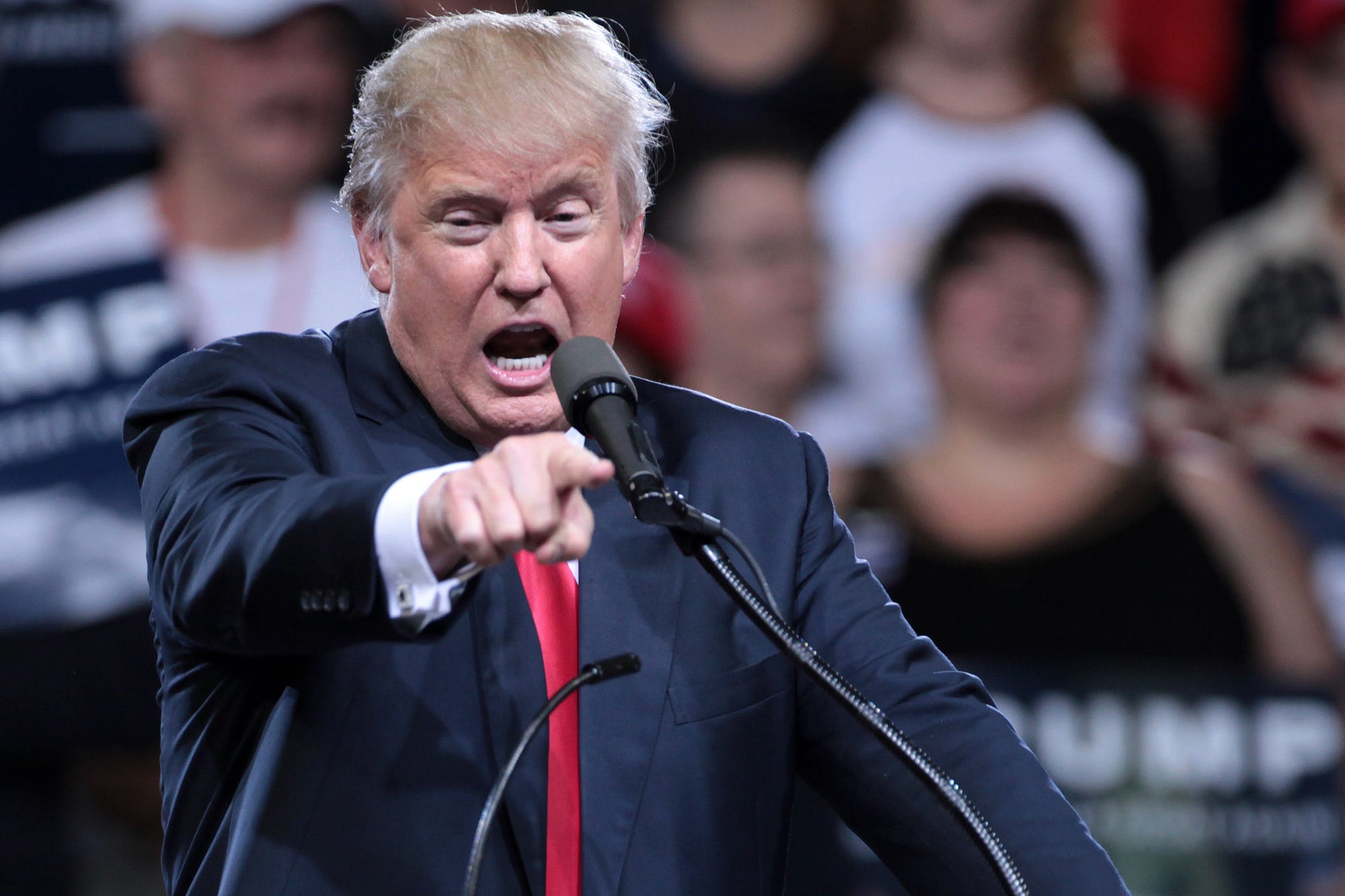
Photo credit: Gage Skidmore
Even after two disastrous debate appearances, overwhelming poll numbers and one of the worst campaign scandals in modern history, if you talk to many reasonable people you’ll still hear this whisper: I really think he might win.
It’s the fear of an electoral surprise—that the pollsters are wrong, that faith in logical, rational voters is faith without evidence. Post-Brexit this sort of skepticism seems even more reasonable. In light of recent events—after all the predictions that were wrong before—how do we even know what everyday people even think these days?
I’ll tell you this attitude is absurd and wrong.
It reminds me of a story that Ulysses S. Grant tells in his memoirs about a night he spent on the wild prairies of East Texas. He and a fellow officer were near Goliad when they heard “the most unearthly howling of wolves” directly in front of them. They couldn’t see the wolves through the tall prairie grass, but the men knew they were near. The other officer asked Grant how many wolves he thought were in the pack. Grant, not wanting to seem afraid, tried to lowball the number at twenty—knowing well enough, he said later, that it was still enough “to devour our party, horses and all, at a single meal.” Grant thought that maybe they should turn around, but the other officer, having come from a part of Indiana where the wolves hadn’t been completely driven out, smiled and pushed on.
The men arrived to find just two lone wolves sitting on their haunches. These were the sole animals who had made all the noise that had scared Grant so badly, that had convinced him he was overwhelmingly outnumbered. Four decades later, after a full life in public service and politics, Grant would relate that he often thought of this incident when he heard of a group changing course due to criticism or someone giving up because they were deterred by an unseen enemy. The lesson in such situations, he concluded, was this: “There are always more of them before they are counted.”
Which brings us to a lesson we would do well to remember in modern media when it comes to politics: There is always less behind the noise than you think.
Certainly this is true in our current election, where the media had tried to convince us that behind Donald Trump is an overwhelming mass of white male blue collar workers who will be rising up as one (or in more extreme characterizations, a raging army of white supremacist lunatics who will riot in the streets if he’s not elected.) Conversely, we’re expected to believe that the unexciting Hillary Clinton is supported by no one, that she’s a candidate created by vested interests, defended by “the media”, and propped up by illusory political correctness—but insufficient votes. The results on election day, the narrative goes, may just shock us.
However alarming these scenarios may be, it belies the objective electoral and demographic facts of this race: That Hillary has a much clearer path to 270 electoral votes than Trump. That, as many smarter people than I have pointed out, there isn’t even enough uneducated white men in America to earn Trump the popular vote either. When a candidate has alienated literally every significant minority voting bloc in this country—African Americans, Latinos, as well as alienating Asian-Americans at an unprecedented rate as the New York Times has shown—they cannot win an election. When they have pissed off huge chunks of their own party—especially the elites, the power brokers, their own running mate and now the dozens who have withdrawn endorsements—they cannot win. And that doesn’t even get into what happens when you run a mismanaged, shoestring campaign.
As David Plouffe, President Obama’s former campaign manager and current informal advisor to Hillary’s campaign, has observed:
“This race is being covered in a way that suggests it’s a dead heat. And it’s not…Some polls closely capture where the race stands. But they’re very incomplete. The Clinton campaign is doing large samples for modeling surveys of everybody on the voter file. So you have a very good understanding of how you believe 100 percent of the electorate will be allocated on election day. When you look at how 100 percent of the vote is likely to be allocated in Florida, I get very optimistic….I can get Donald Trump to within two or three in Pennsylvania, but I can’t get him to a win number. The same is true in Virginia and Colorado. I know everybody goes crazy about the latest Cheetos poll, but I feel very confident about both New Hampshire and Florida. So that puts her over 300 [in the electoral college]. Trump has to pull off a miracle in the electoral college.”
To think that since Plouffe wrote that, Trump not only hasn’t pulled off any miracles, he was caught in one of the most embarrassing hot mic scandals since the invention of recorded sound.
But I actually want to put that aside for a second so we can look at the boom-and-bust cycle of political movement in this country, particularly as it pertains to the media. Because it, as opposed to the surprising results of Brexit, is a far more predictable historical record to study.
We seem to have forgotten the burst of enthusiasm and interest in the largely internet and college-driven campaign of Howard Dean in 2004 (then he finished third in Iowa). We forget Ron Paul at the beginning of the 2008 election as another internet-driven sensation which caused many to ask whether we’d finally found a viable outsider candidate. If you spent any time online in 2007, it was really made to look like we might have (when the reality, of course, was we hadn’t). Very few seem to remember that the 2012 election was presented as a horse race (and in fact, Romney so believed it, he thought he might win!) Of course, the results were anything but close, with Obama securing 332 electoral votes and nearly 5 million more popular votes. How quickly we forget just months ago that Sanders was on the rise, that he was activating loyal young voters who would drive him past Hillary (and then, if they didn’t, at the very least wouldn’t back the ultimate nominee)? And let’s not even get into the Gary Johnson and other third party candidate nonsense of earlier this summer.
All these failed movements were defined by their claims to an ascendent voter bloc—one that the elites didn’t understand, that hadn’t been tracked before, that was going to surprise everyone. The only real surprise was how much none of this materialized.
Yet here we are again.
I think it’s about time we start to recognize that in an insatiable media system, fringe candidates—from Dean to Ron Paul to Sanders to Trump—operate a lot like those wolves that Grant met out on the plains. It’s a fact that in a system which favors extreme views and has an insatiable need for conflict, extreme and conflicting stories will be overrepresented. When candidates without a coalition see the bandwagon effect as their only hope, they will attempt to exaggerate their reach and the size of their base. They will over-rely on the rabidity of their fans to compensate for the big gaps in the lines. It will seem like there are many millions of them…until they are ultimately counted. Because noise carries further than signal right up until the point that the signal gets dialed in.
I’m not saying there were no Sander supporters and certainly no one denies that millions of people will be voting for Donald Trump. It’s just that enough non-stop coverage can skew the estimates and expectations of even the most rational observers. When you’re on Reddit or Facebook and every reasonable comment is followed up by dozens of intensely argumentative responses from Bernie Sanders or Gary Johnson supporters it can start to feel like there are a lot of them out there—that there is a real movement afoot.
Certainly, the Republican party fell for this in the primary, mistaking the fact that Trump seemed louder and bigger than his early opponents for a realistic chance of putting enough electoral points on the board to win. In fact, Trump has often touted—and exaggerated—the sizes of his rallies, as if that stat mattered. Today, Republicans and Democrats are falling for it again.
When you go on Facebook and see endless amounts of anti-Hillary memes, you might start to think: Man, people really hate her. Sure some do—and many polls show that Americans have trouble finding her trustworthy—but even her “unpopularity” is not as unclear as it looks. The Daily Beast recently outed the almost-billionaire and founder of Oculus, Palmer Luckey, for secretly “putting money behind an unofficial Donald Trump group dedicated to “shitposting” and circulating internet memes maligning Hillary Clinton.” There are also the reports that have shown how potentially a significant number of Trump’s Twitter followers are fake accounts. And of course, there were the internet trolls of suspected Russian origin which broadcast pro-Donald support and propaganda. In Business Insider’s piece on astroturfing, they quote Adrian Chen, who researched Russian trolls for a New York Magazine story in 2015, talking on the Longform podcast,
“I created this list of Russian trolls when I was researching. And I check on it once in awhile, still. And a lot of them have turned into conservative accounts, like fake conservatives. I don’t know what’s going on, but they’re all tweeting about Donald Trump and stuff.”
I don’t know if those were the people who started tweeting at me when I wrote two Trump pieces over the summer, but I can tell you, I don’t normally receive many responses to my writing from people with 7 followers (in one case, the “person” had literally zero followers—which I didn’t know was even possible). I do know that the people who disliked the article were far more vocal and loud and obnoxious that the ones who agreed. I happened to have a pack of coyotes living near my house—which can often sound like they’re right next to my window—and the upside is that I’ve gotten good at ignoring empty noise.
Another version of this throwing of sound is in internet polls, which candidates like Ron Paul, Donald Trump and even Bernie Sanders have often dominated. People don’t understand that this is often deliberate manipulation. For instance, Trump’s fans on 4chan and reddit made an explicit effort to have Trump win in every online poll around the outcome of the first debate—which Trump excitedly tweeted the results of—with users explaining how to cheat the system and vote again and again in each poll. Philip Bump in The Washington Post has compared this online behavior to a Trump rally: “These online polls are, again, garbage, no more representative of the population as a whole than is the crowd at a Trump rally. That comparison is very apt, in fact. The crowd at a Trump rally 1) is open to all comers, 2) is geographically isolated, meaning that while anyone can attend, it doesn’t include a huge swath of people who vote, and 3) it rewards enthusiasm in a way that tends to obscure actual interest.” (I’d also add that many attendees admit to showing up to Trump rallies “for the spectacle.”)
It’s those last few points that are most interesting to me—in fact, they point to a fundamental reality of the internet. Not only does research show that anger is the most viral and provocative emotion—meaning that angry Trump supporters are going to be far more active than a resigned Clinton voter—but silence is often misinterpreted. Going back to what one programmer defined as Warnock’s Dilemma, it’s very hard to know what to make of a lack of response. The media’s typical reaction is to cater to active audiences. If something is being shared, they cover it more. There is no positive sign of people simply nodding their head and moving on—a common reaction to common sense, middle of the road content—so there is no way to skate to that puck. By definition, normal, reasonable people are not an audience you can pander to.
In the same way that no amount of media fawning makes HBO’s Girls more popular than The Big Bang Theory, no amount of Trump media coverage changes his fundamental demographic issues. It has been the inability of his now alt-right driven campaign to realize this that doomed him from truly capitalizing on voter’s real desire for change. It’s what makes his most recent debate performance irrelevant. He landed plenty of punches on Hillary…but it pleased the crowd and not the referee-like undecided voters he needed so desperately to add to his base.
Yes, it seems like there are huge amounts of Trump supporters out there. They are by definition louder and more motivated. They are naturally more compelling to cover. They are also engaged—or complicit—in forms of manipulation designed to create the sense of a movement which can’t be stopped. Clinton hides from media coverage and doesn’t make herself available even to be interviewed. Both approaches create feedback loops in which support for the former appears greater than support for the latter, because one is vocal and loud while the other is implicit and begins and ends at the ballot box.
All of which brings us to where we are now. A good portion of Trump’s supporters are not dumb—just as Sanders and Dean and Romney’s weren’t. Like Grant, they’ve just fallen for the noise. Some are excited by it, some are scared, some just don’t know what to believe anymore. But it’s all the same fundamental mistake.
The underlying numbers haven’t changed. We’ve just been gaslighted. The path to a Trump victory remains as unlikely—if not impossible—as it always was. Not only electorally, but personally—because every time Trump does get momentum, like clockwork, he rips off his Hannibal Lecter mask and says what he really thinks, ruining the very momentum his discretion had created. The only rotating variable is the media’s interest in keeping things interesting and the natural phenomena of how noise carries.
Hillary Clinton will almost certainly win. It is not a surprise. The only part likely to change is by how much or by how little.
I’m not just telling myself that so I’ll feel better. I’m not hoping that’s the outcome. I know the dangers of that. I’m also not running around getting worried and anxious as a form of virtue signaling.
Both are pointless exercises rooted in the same bad assumption. The Stoic philosopher Hecato has said that hope and fear were the same. They are both based on irrational projections—of following the noise and ignoring the tricks that noise can play on you.
What’s better is truth. What’s better is counting the voices, not measuring their volume.